Month: October 2025

Event Outreach

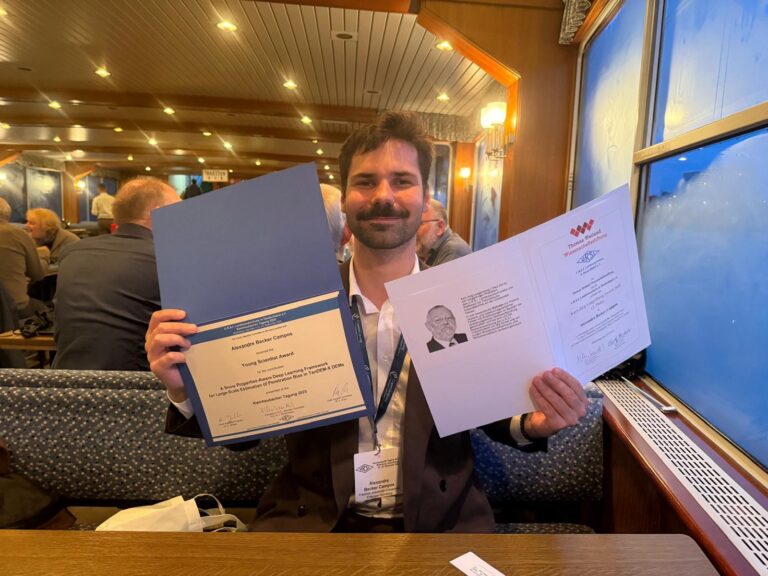
Young Scientist Award and Karl-Jörg Langenberg Award for Alexandre Becker Campos

With great pleasure we announce that Alexandre Becker Campos received two awards, the Young Scientist Award and Karl-Jörg Langenberg Award (Best Paper Award, second place) at the Kleinheubacher Tagung 2025 with his work entitled “A Snow Properties-Aware Deep Learning Framework for Large-Scale Estimation of Penetration Bias in TanDEM-X DEMs.”
This work demonstrates that the proposed physics-aware, AI-based approach can compensate biases in TanDEM-X digital elevation models (DEMs) with centimeter-level accuracy over ice sheets and can support glaciological applications such as snow depth estimation and mass balance of glaciers.

We congratulate Alexandre on his outstanding work and on these special awards!

Publications

A Kalman filter-based framework for assimilating remote sensing observations into a surface mass balance model

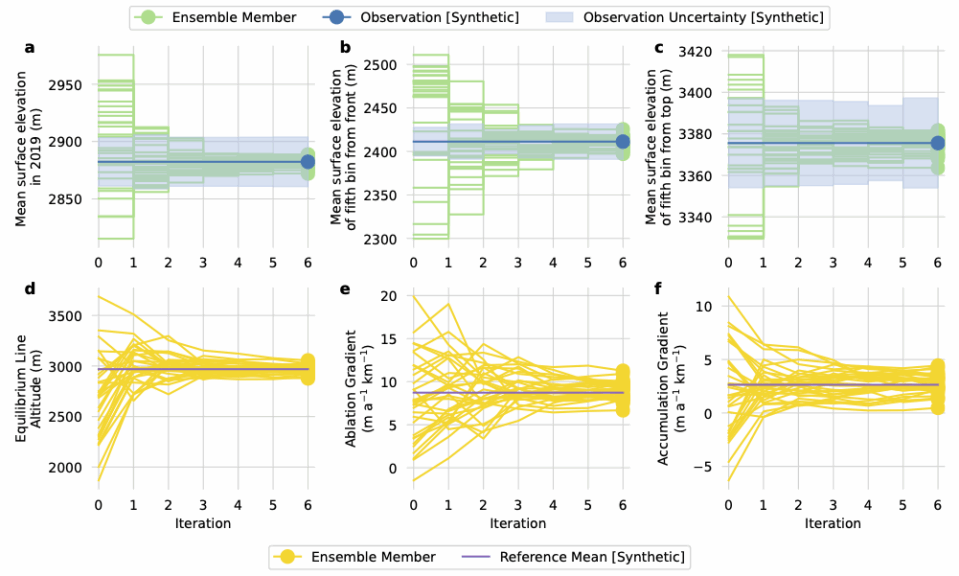
This study introduces a custom implementation of the Ensemble Kalman Filter (EnKF) for calibrating a three-dimensional glacier evolution model. The EnKF can assimilate observations as they become available and provides uncertainty measures for the initial state after calibration. We calibrate an elevation-dependent surface mass balance (SMB) model using elevation change observations and test the EnKF’s performance in a Twin Experiment by varying internal and external hyperparameters. The best-performing configuration is applied to the Rhône Glacier in a Real-World Experiment. Using satellite-based elevation change fields for calibration, the EnKF estimates an average equilibrium line altitude of 2920 ± 37 m for the period 2000–2019. A comparison of the results with glaciological measurements demonstrates the capabilities of the EnKF to simultaneously calibrate multiple SMB parameters. With this proof of concept, we expect that our methodology is readily extendable to other map or point observations and their combination, as well as to other calibration parameters.

Publication available on: https://doi.org/10.1017/aog.2025.10020

Allgemein Outreach

Nora Gourmelon’s research on AI technology for glacier changes featured in FOCUS article

Nora Gourmelon, a PhD student at the Pattern Recognition Lab and part of M3OCCA, was recently featured by FOCUS in an article highlighting her research on monitoring glacier retreat with artificial intelligence. The feature, titled “Deutsche Forscherin entwickelt Technologie, die das Sterben der Gletscher offenbart”, presents her work on developing AI-based methods to automatically analyze radar satellite imagery and reveal changes in Arctic glaciers.

Her research contributes to the broader effort of using “green AI” technologies to support climate science and environmental monitoring.

Read the full article here: focus.de

Outreach

Guest Talk at the Indian Institute of Science (IISc) Bengaluru, India 2025

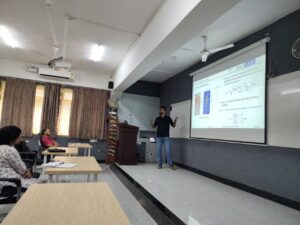
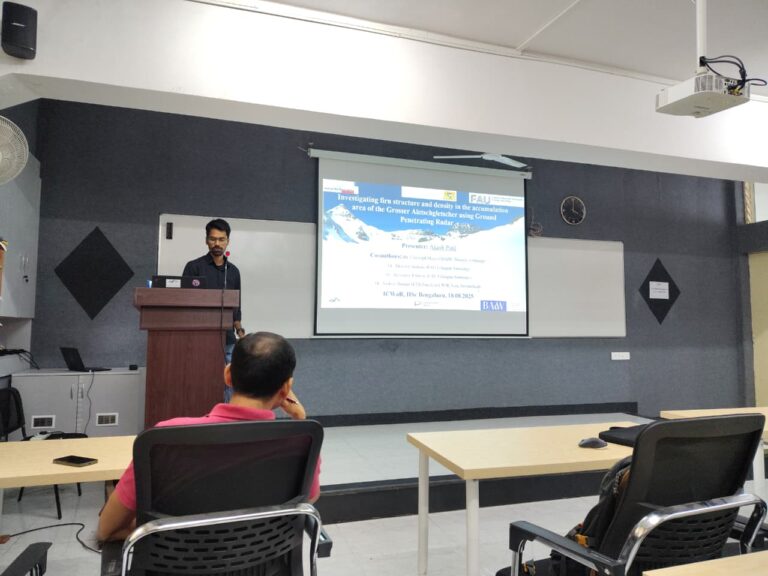
In 2025, Akash Patil presented his research on “Investigating firn structure and density in the accumulation area of Aletsch Glacier using Ground Penetrating Radar” in the monthly seminar series organized by Dr. Brahma Dutt Vishwakarma at the Interdisciplinary Centre for Water Research (ICWaR), Indian Institute of Science, Bengaluru. The seminar brought together PhD students and postdoctoral researchers from a wide range of disciplines, including gravimetry for groundwater monitoring, glacier lake outburst floods (GLOFs), and remote sensing and geophysical approaches to glacier mass balance. This was a great opportunity to share Akash’s work, exchange ideas across fields, and build possible collaborations aimed at advancing our understanding of Himalayan glaciers, which are increasingly affected by glacierrelated flood events in recent years.